Jay Kelly
★★★ 1/2
Jay Kelly (Netflix) is very much a Noah Baumbach movie, for better and for worse. If you’re already on Baumbach’s wavelength, you’ll know exactly what that means.
I’ve long been a fan of Baumbach, not because his films are visual showpieces, but because they live and die by character. He’s one of our sharpest writers when it comes to people at emotional crossroads—those moments where life quietly (or loudly) asks, “Is this really working?” He usually balances that existential ache with just enough wit and humor to keep things human instead of heavy-handed.
Jay Kelly isn’t among his best work, but I still found it genuinely engaging, especially in concept. The film centers on Jake Kelly (George Clooney), a legendary Hollywood actor who has achieved exactly what he set out to accomplish professionally, only to reckon with the personal sacrifice that success often demands. It’s the ultimate struggle between devotion to your calling and what personally fulfills you. Is the sacrifice required by art—by Hollywood, by ambition—worth the cost to your family, friendships and the people who know you outside of the spotlight?
Casting Clooney as Jake Kelly is inspired in a very meta way. Clooney’s real-life status as a Hollywood icon adds immediate weight to the role. You can’t help but make the mental leap that this is someone who has been revered for decades. While Jake Kelly’s story isn’t a mirror of Clooney’s own, the casting does a lot of the work for Baumbach, making it easy to buy into the mythology of this character, especially as we watch him receive tributes overseas for his body of work.
The film is at its strongest early on. It’s contemplative and philosophical, and it had me thinking deeply about my own balance between work and family. I connected strongly to the idea of cultivating personal skill sets and being successful in the world because of them. But also to the competing desire to build a life where the people you love feel seen, valued and cared for. Baumbach is the perfect filmmaker to wrestle with these questions, and when Jay Kelly slows down and sits in those ideas, it’s quietly compelling.
As Jake journeys to Italy for a major tribute, he begins to lose pieces of his personal orbit—members of his entourage, emotional connections and a sense of stability—and the film tracks that unraveling. Some of these moments work beautifully. Others feel less fully realized. Baumbach weaves in a handful of subplots that don’t entirely land, and several of the supporting characters never quite feel fleshed out. There are flashes of real, lived-in emotion, but they’re often followed by stretches that feel more familiar or even cliché.
Billy Crudup appears early on and initially hits it out of the park, delivering one of the film’s more striking performances. Unfortunately, his character eventually slips into something closer to a stock role, losing some of the specificity that made him so compelling early on. That problem extends to much of Jake’s entourage (including Laura Dern and Emily Mortimer), whose motivations are often underdeveloped.
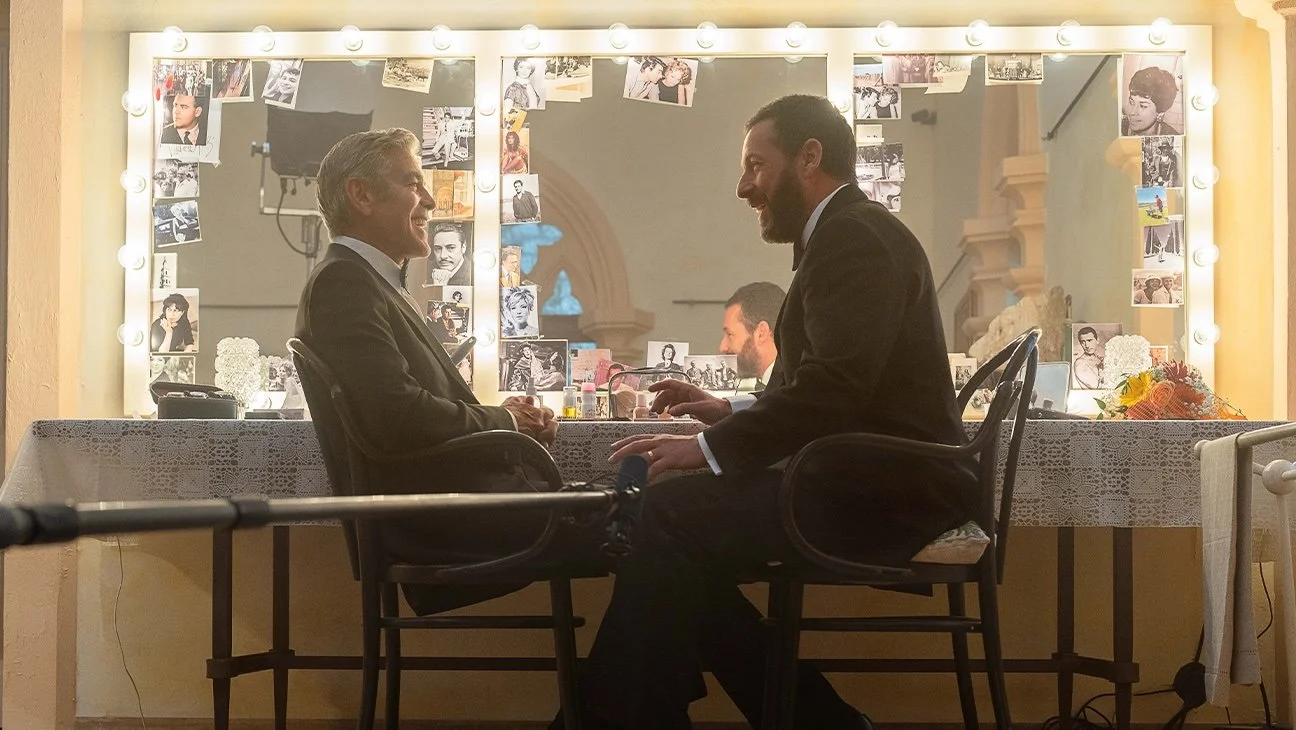
The dynamic between Clooney and Adam Sandler, who plays Jake’s longtime manager, is interesting but uneven. Baumbach has used Sandler effectively before, and Sandler clearly understands the rhythms of this world. Still, I never fully bought him in this particular role. Both actors are Hollywood icons in very different ways, and while that contrast is intriguing, their pairing never quite clicks the way it could have. There’s a version of this movie where you want to see Clooney and Sandler sharing more scenes together, and this just isn’t that film.
If you love movies about movies, Jay Kelly is still a fascinating, self-aware look at the machinery of fame and the emotional toll it takes to get there. That kind of introspection will inevitably feel pretentious to some viewers. My wife summed it up pretty well by saying the film sometimes feels like it’s trying too hard, and I don’t completely disagree. Still, there’s value in how the film pushes you to examine what sacrifices you’re personally willing to make to achieve professional success.
Also, kudos to the opening shot of the film, which weaves you in and out of a scene being filmed for one of Jay Kelly’s movies in a single, fluid take. It immediately pulls you into the world and sets the tone for what’s to come. There’s an unspoken rule with movies about movies: you need to flex a little, and that opening one-take feels like Baumbach quietly proving he has the technical confidence to play in that space. It’s an effective way to signal that this is a film very aware of its own subject matter.
In the end, Jay Kelly is an imperfect but thoughtful character study. It works best when it’s asking big, uncomfortable questions and falters when it tries to tie them up too neatly. Not top-tier Baumbach, but still a worthwhile watch if you’re drawn to introspective films that linger in your head long after the credits roll.